

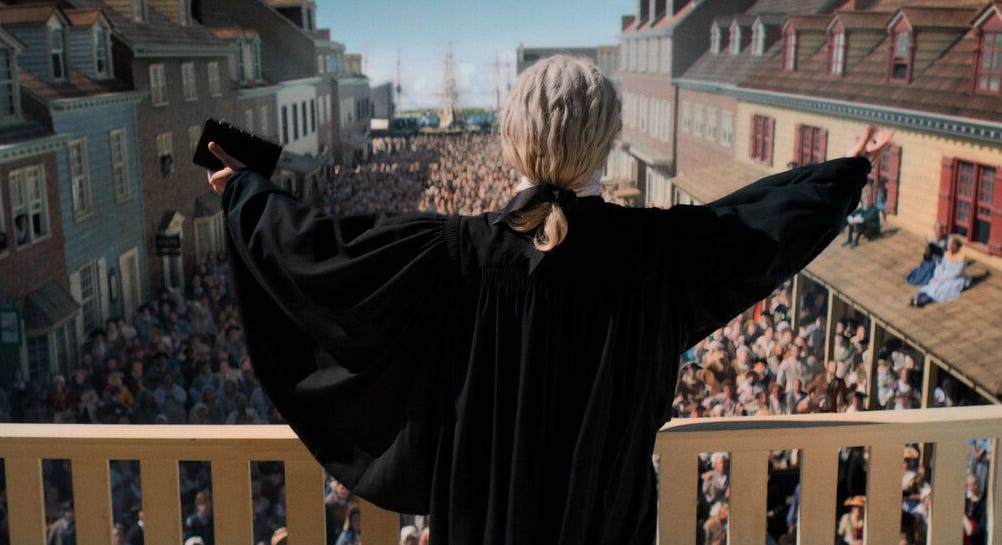
I went to see A Great Awakening over the weekend and, as expected, enjoyed it very much. (What else would you expect from a guy with a doctorate in history who hosts a site called “The Next Great Awakening”?) I give it an enthusiastic thumbs up, with the caveat that fitting forty-plus years of history into two-plus hours of screen time always comes with certain challenges.
This new film tells the story of the intriguing relationship between the revivalist George Whitefield (pronounced Wit-field) and Benjamin Franklin, mostly from Franklin’s perspective looking back on it from the time of the American Constitutional Convention of 1787. It’s a story that should be well-known to all Americans and isn’t, but at least it’s being told in a popular medium now (even if not in nearly enough theaters).
Sticklers for details might have some gripes with A Great Awakening. As with most based-on-history films:
Years of the story are compressed into single summary scenes. For example, there’s a scene of Whitefield preaching in an Anglican church in which he throws off his wig and robe, denounces the local rectors, delivers a fiery sermon that excites some and infuriates others, opens the doors to welcome black people who were apparently (and oddly) waiting outside, and vows to take his preaching to the open fields — all of which, in very broad brush strokes, represents developments that happened over several years.
Nuanced issues come out flat and static in brief dialogues — like Whitefield’s position on slavery, which is mentioned but somewhat caricatured here; or Franklin’s comment that Whitefield was not only thrown out of the Anglican Church but also the country, which is figurative at best, and even then not particularly accurate. He carried out ministry in both Britain and the Americas, traveling to the latter seven times while remaining based in England.
Characters are sometimes overplayed for effect (not everyone was suddenly amazed or moved by Whitefield’s preaching; some people took time to warm up to him) . . .
Or they are idealized without exploring the complexities of their struggles and relationships (i.e., the tension between Whitefield’s theology and that of his friends the Wesleys, the formality of his marriage and how it took a distant backseat to his ministry, etc.) . . .
Or, like Admiral Howe near the end of the film, they are villainized to provide a dramatic foil for the protagonists. (Portrayals of other villains, like the aristocratic Oxford students who tormented Whitefield and the prominent actors who mocked him from the stage, are sadly not inaccurate.)
Those would all be fair critiques. Though the movie will rightly resonate with evangelicals, non-Christians might see it as religious propaganda because of the overt gospel messaging throughout. (Of course, it would be extremely difficult — and dishonest — to tell Whitefield’s story without quite a bit of gospel messaging, since that’s really what he was all about.)
But to any critics who think the story is overplayed, I’d simply respond that:
Whitefield really did preach the sermons depicted in the film.
He really did reach celebrity status, with multitudes tracking his travels and flocking to his sermons when he was in their area.
He and Franklin, who were very unlikely but surprisingly close friends, really did carry on the kinds of conversations portrayed in the movie.
And the spiritual awakening of the mid-1700s, for which Whitefield was the most prominent figure in the Americas, really did have a profound effect on American colonists’ values for freedom and personal rights, and therefore on the formation of the nation itself.
These facts might be summarily dismissed by moviegoers who don’t want a heavy dose of religion in their entertainment (though they likely aren’t the ones going to see this film). Yet they are facts nonetheless — none are disputed by anyone who knows the history of this period — regardless of the artistic license taken here.
Having seen the entertainment industry downplay the religious convictions of historical characters (or marginalize them to niche, faith-based productions) for most of my life — as if the general public can’t be expected to stomach the bold and very public faith of past generations — I’m okay with the brazen, in-your-face convictions of people like Whitefield and Wesley, even if they are over-dramatized a bit. (And if that’s the case in this movie, it’s not by much, as Great Awakening preachers were hardly politically correct, even for their times.)
It’s therefore gratifying to see in this movie two very different people with conflicting perspectives on life having intelligent, mutually respectful, mature conversations about their differences and still getting along with each other very well. What a concept! Americans of all persuasions, take note.
An even more gratifying aspect of this movie is that it emphasizes the clear connection between the First Great Awakening and American independence. It’s true that Enlightenment values also informed the American Revolution and Constitution — both the secular and religious trends of that century set the stage for the crazy ideas that “all men are created equal” with God-given rights and self-government is desirable — but the spiritual principles underlying the Constitution, though admittedly often exaggerated by evangelicals, are more often under-appreciated by today’s historians. In reality, Christianity along with its values — as a living faith for some and a formative cultural context for others — profoundly shaped the new nation.
Or, to take it a step further, revival changed the world.
In any case, I highly recommend this movie for anyone who is interested in American history and willing to face the very conspicuous Christian messaging within it (“it” being history, not just the film). Whitefield’s voice was not by any means the only one to influence American spiritual values in the eighteenth century, but it was a hugely significant one, and putting it in front of today’s audiences is a very good thing.
Saw the movie yesterday and wanted to learn how true to history it was. Found your substack during my research and really appreciated your post on this subject!
It was a very good movie!